
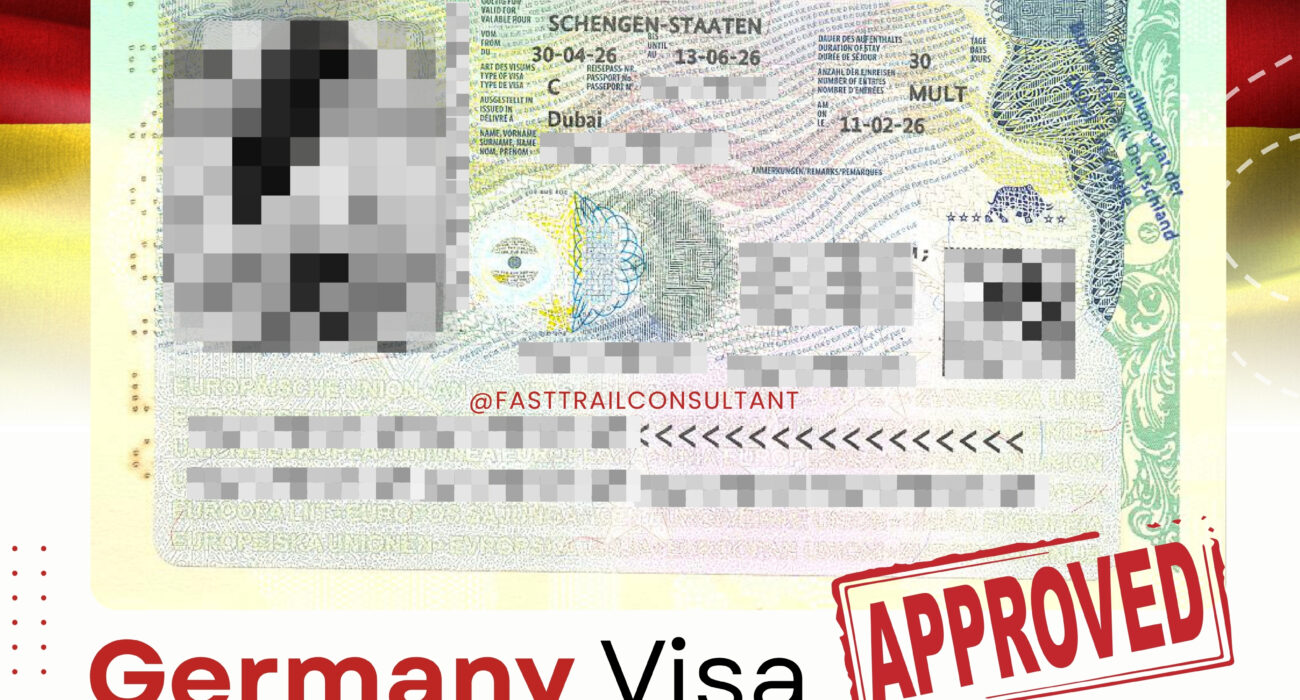
If you live in Dubai, Abu Dhabi, Sharjah, or anywhere else in the UAE and you’re planning a trip to Germany, understanding the Germany visa requirements for UAE residents comes down to three things: whether you’re eligible to apply from the UAE in the first place, which documents your specific visa category needs, and whether you follow the application sequence in the right order. Get any one of these wrong (an Emirates ID issued too recently, a missing insurance certificate, or a form submitted through the wrong portal) and your file gets delayed or rejected before a visa officer even reviews your reason for travel. This guide walks through all three in the order the German Consulate General in Dubai actually checks them, so you can build a file that holds up the first time.
Who Needs a Germany Visa When Applying From the UAE?
Whether you need a visa for Germany depends entirely on your passport, not on your UAE residence status. Holding a valid Emirates ID or UAE residence visa does not exempt you from Germany’s entry requirements; it only determines where you apply.
Germany is part of the Schengen Area, a bloc of 30 European countries that share a single short-stay visa policy. Passport holders fall into three groups:
- EU/EEA and Swiss citizens: free movement, no visa needed at all.
- “Annex II” visa-exempt nationals: passport holders from countries such as the UK, USA, Canada, Australia, Japan, South Korea, and most non-EU European states can enter visa-free for up to 90 days in any 180-day period.
- Everyone else: most South Asian, African, Southeast Asian, and Middle Eastern passport holders (including the large Indian, Pakistani, Filipino, and Egyptian communities in the UAE) need a Schengen visa before travelling, regardless of how long they’ve lived in the Emirates.
UAE (Emirati) passport holders are currently visa-free for stays of up to 90 days. You may see claims online that ETIAS, a pre-travel screening system, not a visa, will make this mandatory from a specific date in 2027. As of now, the EU has pulled its earlier Q4 2026 launch target and has not confirmed a new date; treat any “April 2027” figure you see as provisional until the European Commission publishes an official timeline.
One more distinction that trips people up: a Schengen (Type C) visa only covers stays up to 90 days for tourism, business, or family visits. If your purpose is study, employment, or family reunification for longer than 90 days, you’re in national visa (Type D) territory, and the eligibility and document rules below diverge for that track.
Germany Visa Eligibility Requirements for UAE Residents
Even if your nationality requires a visa, the German Consulate in Dubai will only accept your application if you clear three separate eligibility checks.
1. Your UAE residency must meet the “habitual residence” rule
This is the one most UAE-based applicants overlook. The German Consulate General in Dubai will only process your file if the UAE is legally recognised as your place of habitual residence, and that’s defined by a specific window on your Emirates ID:
- Your Emirates ID must have been issued at least 6 months before your application date.
- Your Emirates ID must remain valid for at least 3 months beyond your intended date of return from Germany.
If either condition fails, the consulate isn’t obligated to accept your case at all, and you’d need to apply through your country of origin instead.
2. Your jurisdiction depends on your emirate
Where you submit your file matters. Applicants based in Dubai and the Northern Emirates apply through the VFS Global centre in Dubai; applicants based in Abu Dhabi and Al Ain apply through the VFS Global center in Abu Dhabi. Submitting at the wrong centre for your emirate of residence can cause processing delays.
3. Your financial proof must match your visa category
There’s no single financial threshold; it scales with what you’re applying for:
| Visa category | Typical financial benchmark |
|---|---|
| Tourist / visit visa | Roughly €50 to €100 per day of stay, shown via 3 to 6 months of stamped bank statements |
| Business visa | Company bank statements plus trade license or a sponsoring company’s invitation |
| Student visa | A blocked account (Sperrkonto) with a fixed minimum balance, held with an approved provider |
| Job seeker visa | Proof of funds covering roughly 6 months of stay in Germany |
A sudden large deposit shortly before you apply is one of the fastest ways to trigger scrutiny; consular officers are specifically trained to look for a consistent balance history, not a one-time top-up.
Documents Required for a Germany Visa From the UAE
Document requirements branch into two layers: a core set every applicant needs and category-specific additions on top.
Core documents (required for every applicant)
- Original passport, issued within the last 10 years, valid for at least 3 months beyond your planned return date, with at least 2 blank visa pages
- Emirates ID meeting the 6-month/3-month rule above (a copy, though carry the original for verification)
- Completed and signed application form via VIDEX (short-stay) or the Auslandsportal (long-stay national visa)
- Two recent biometric passport photos, white background, per German specifications
- Bank statements for the last 3 to 6 months, officially stamped by the bank
- Travel/health insurance valid across the entire Schengen Area with a minimum of €30,000 medical and repatriation coverage
- Confirmed round-trip flight reservation
- Proof of accommodation: hotel booking, signed rental agreement, or a formal invitation letter if staying with someone
- Proof of employment or business activity (salary certificate and NOC for employees; trade licence and company statements for the self-employed)
Additional documents by visa category
Tourist / visit purpose
- Day-by-day travel itinerary
- Evidence of ties to the UAE (employment continuity, property, family) that support your intent to return
Business visa
- Invitation letter from the German host company, or trade fair/exhibition registration
- Company NOC and a cover letter outlining the business purpose
Student visa
- University admission letter (conditional or unconditional acceptance)
- Blocked account confirmation from an approved provider
- Academic transcripts and certificates, with certified translations where required
- Language proficiency certificate matching your programme’s medium of instruction
- APS certificate: mandatory for Indian, Chinese, and Vietnamese passport holders; applications from these nationalities are not processed without it
Work / skilled worker visa
- Signed employment contract or confirmed job offer from a German employer
- Recognition of foreign qualifications (Anerkennungsbescheid), where applicable
- Language proficiency proof appropriate to the role
- APS certificate for Indian, Chinese, and Vietnamese applicants
Job seeker visa
- Recognised degree certificate with certified translation
- A cover letter setting out your professional background and job-search plan
- Proof of funds covering roughly 6 months in Germany
Every document set should visibly match the stated purpose of travel. A tourist file padded with employer sponsorship letters, or a business file with no company invitation, is one of the more common reasons applications get sent back for clarification.
Germany Visa Application Checklist (Step-by-Step)
Use this as a working checklist once your documents are ready.
- Confirm your visa category first. Tourist, business, student, work, or family reunification each triggers a different document set; decide this before collecting anything.
- Check the timing window. Applications can be submitted up to 180 days before travel for short-stay visas, but shouldn’t be registered too close to your travel date either; apply at least 4 to 6 weeks in advance, earlier during June to August and December.
- Register and complete your form online. Short-stay applicants use VIDEX; long-stay national visa applicants use the Auslandsportal. Every field must be completed; leaving an inapplicable field blank is a common reason forms get rejected at the counter.
- Cross-check every detail against your supporting documents. Names, dates, and passport numbers on the form must match your passport and Emirates ID exactly.
- Assemble your document file in order: core documents first, category-specific documents after, arranged the way your visa type requires.
- Book your VFS Global appointment at the centre matching your emirate of residence (Dubai or Abu Dhabi).
- Pay the visa fee in cash (AED) at the VFS counter. This fee is non-refundable regardless of outcome.
- Attend in person for biometrics. Fingerprints and a photograph are mandatory for applicants aged 12 to 70.
- Track your application status and respond promptly if the consulate requests additional documents.
- Collect your passport once processing is complete. Standard Schengen processing runs up to 15 working days, though peak-season and national-visa applications take considerably longer.
Frequently Asked Questions
Does my UAE residence visa exempt me from needing a Germany visa?
No. Visa requirements are based on your passport nationality, not your UAE residency. Your Emirates ID only determines where in the UAE you’re eligible to apply.
How far in advance can I apply for a Germany visa from the UAE?
Up to 180 days before your travel date for short-stay Schengen visas. Applying too close to your travel date is riskier, since standard processing takes up to 15 working days and can extend well beyond that during peak periods.
What happens if my Emirates ID doesn’t meet the 6-month rule?
The German Consulate General in Dubai isn’t obligated to process your case if your Emirates ID was issued less than 6 months before your application, or expires within 3 months of your planned return. You may need to apply through your home country’s German mission instead.
Do I need a blocked account for every visa type?
No. The Sperrkonto (blocked account) requirement applies specifically to student visa applicants. Tourist and business applicants show financial capacity through bank statements instead.
Is the APS certificate really mandatory?
Yes, for Indian, Chinese, and Vietnamese passport holders applying for a student or work visa. Applications from these nationalities are not accepted for processing without it, and it should be arranged well before you assemble the rest of your file, since it takes time to issue.